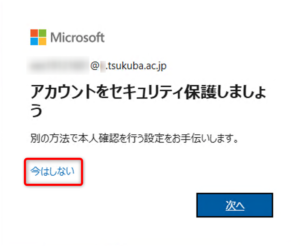
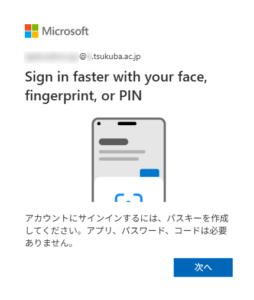
When you sign in with your @u or @un Microsoft 365 account, the “Let’s keep your account secure” screen may appear. After you select “Next,” you may then see the “Sign in faster with your face, fingerprint, or PIN” screen.
These screens guide you through setting up a passkey for signing in to Microsoft 365.
Currently, setting up a passkey is optional.
If you would like to set up a passkey, please refer to the following instructions:
for Windows: How to sign in to Microsoft 365 using passkeys –with Windows Hello–
for Mac: How to sign in to Microsoft 365 using passkeys –with iCloud Keychain–
(Please log in with your Unified Authentication ID/PW when accessing this page.)
If you do not want to set up a passkey, on the “Let’s keep your account secure” screen, select “Not now” or simply close the screen.
If you did not receive a code when signing in to Microsoft 365, or if you did not receive a code due to a change of device, please click here.
*Unified Authentication System is required to view the site.
Information signed in with other previous accounts such as @s.tsukuba.ac.jp account may be saved in the browser cache and cookies. Because of this, even if you intended to be signed in at @u.tsukuba.ac.jp, you may be signed in at @s.tsukuba.ac.jp.
Please delete your browser cache and cookies, or check if it’s available in other browsers such as “Microsoft Edge”, “Google Chrome”, “Firefox”, or use different device.
Logging into the Office 365 Portal requires a new password, which is defined by the user upon signing up for EES advantages instead of the unified verification password.
Apparently, you can receive some charge-free services from Microsoft by creating a Microsoft ID using your personal email address. That is not related to this service of ours. We do not recommend using your @s, @u or @un email address to create your Microsoft ID. That could cause a problem when you receive services from the University of Tsukuba.
Do it by
- Sign-in yourself in https://myaccount.microsoft.com/
- Click the “My sign-ins” in the left-edge menu
- Your recent active sign-in history is displayed
For detail, also refers to Microsoft’s newest document. (eg. search keywords “Microsoft365 recent activity” and read the Microsoft Support in that page.)
If you also want to change your password, please read this QA, ignoring the URL told in that document.
Part-time lecturers, professors, associate professors, special professors, visiting professors, and adjunct researchers who wish to receive the @u.tsukuba.ac.jp email address should submit an application form below and attach a copy of an ID card issued by the university.
■ACCC System Account Application Form -PDF-
You need your @u .tsukuba.ac.jp email address in order to self-register the EES benefits to use MS Teams, etc.
If you want to join Teams or Streams for the university, you need to sign in with your @u. tsukuba.ac.jp email address that you have signed up for ESS.
This issue may be caused by a sign-in authentication error within the application. Please try the following methods.
(For Windows) — For the Mac version, refer to the corresponding Mac FAQ
- If possible, sign out of your Microsoft 365 applications such as Office (Word, Excel, etc.) and the Teams app, then close them. If you cannot sign out, simply close the applications.
- Click the [Start] button at the bottom-left corner of your Windows screen, then click [Settings] (gear icon).

- Select [Accounts] → [Access work or school].

- Confirm whether the university Microsoft account used for license activation (ending in @u or @un) is listed under Access work or school.
If it is not listed, proceed to Step 6.
- Select the account you wish to sign out from, then click [Disconnect].
※This is not the OWA (Outlook Web App) domain join entry for @un accounts — please make sure you select the correct one.

- Restart your PC.
- After restarting, launch Office (Word, Excel, etc.) or Teams, and sign in using your university Microsoft account (ending in @u or @un).
★When [Sign in to all apps, websites, and services on this device?] screen (confirming my organization to manage my device) appears, click “No, this app only.”

If the error message “Another account from your organization is already signed in on this computer” still appears after performing the steps above,
refer to the following Microsoft support page, which may also be helpful:
Microsoft 365 apps activation error “Another account from your organization is already signed in on this computer”
The display name for Microsoft 365 services (such as Outlook, Teams, etc.) can only be changed by the system administrator.
If you wish to change your display name to roman letters (for example, to facilitate communication with international collaborators or for work-related reasons), please read the following notes carefully and contact us via the inquiry form with the required information.
Important Notes Regarding Display Name Changes
- The change will apply not only to your @u / @un email (Outlook) or Teams account name, but also to all Microsoft 365 services, including OneDrive, SharePoint, and others.
- Since this change can only be made by the administrator, repeated or frequent requests (e.g., switching back to Japanese for meetings, etc.) cannot be accommodated.
Required Information
Please fill in the following details when submitting your inquiry:
-
Inquiry Title:
“Microsoft account display name change request”
-
Inquiry Content:
- Reason for the change
- Current display name
- Desired new display name
Example: “Taro Tsukuba” or bilingual “Taro Tsukuba / 筑波太郎”
- Unified Authentication ID (UTID-13)
- University email address (@u or @un)
Inquiry Form:
https://www.cc.tsukuba.ac.jp/wp_e/contact/ees_inquiry/
Please note that processing your request may take some time.